So I finished the working draft for Maiden before Christmas and sent it out to a few beta-readers, including my wife. When you hear one thing, you can dismiss it. When you hear it again, there might be something. But when multiple people give you the same exact feedback…you listen.
A Better Understanding
Eric reluctantly walked into Mr. Walker’s class.
“I’m glad you decided to stay for detention instead of making it worse,” Mr. Walker said, looking up from his desk. Eric walked past his seat in the front row to the back of the room and sat down, not responding. Mr. Walker looked at Eric, as if to say something, but he went back to working on his papers.
“Well, I’m here,” Eric said, throwing his hands up. “You won. Give me some work or something.”
Mr. Walker put his pen down, picked up a stack of papers on his desk, and stood up. “I’m just trying to help you, Eric. It’s not my…”
“Look, I don’t need your help,” Eric said defensively.
Year after year, school after school, teacher after teacher, that’s all he was…someone that needed help. Another project. Another young man from the streets that some stuck up, well bred, college educated teacher could help in order to make themselves feel better over dinner conversations with their friends. Only four weeks into school and Eric had already been suspended once for fighting and a handful of detentions for tardies and mouthing off.
Eric knew he had problems. They were his problems. He didn’t need anybody to fix him. He didn’t want anybody to try.
Mr. Walker stopped at the front of the row. “Look, Eric. I’m not sure why you went off today in my class. I didn’t push Vice-Principal Harmon to give you a suspension, cause missing school doesn’t do you any good. I think you are capable of the work. I just want to try and understand a little more what I can do…”
“You don’t need to understand anything,” Eric snapped. “All you need to do is give me my work and leave me alone.”
Mr. Walker looked, again, like he wanted to say something. It seemed Mr. Walker always wanted to say something. Like there was something on his mind that he needed to share with Eric, but never did.
Just give me the stupid work, Mr. Walker. Don’t try to figure me out. You don’t know me. You don’t know nothing about me.
Mr. Walker took off his glasses, wiped them on the back of his tie and put them back on.
Don’t say anything else Mr. Walker. Just let me be.
“Look Eric, I just…”
“Damn it, man,” Eric said, standing, pushing the desk aside and starting down the row. “Why can’t you just let me be. I told you, I don’t need your help and I don’t want your help.”.
Mr. Walker stood his ground at the end of the row, but made room so Eric could pass.
“I can’t let you be Eric, because I care. Why is that so hard for you to believe?” Mr. Walker asked. Eric felt a hint of sincerity, but his anger let it slide.
“Ain’t no way you have any clue what I’m going through. You can’t even pretend to know anything about me,” Eric said, stopping short of the door, moving closer to Mr. Walker. “Just leave me…”
“Sorry to drop in on you honey, but we…” a lady said walking into the classroom. “Oh my goodness, I am so sorry. I didn’t know you would have a student with you.”
“It’s no problem. Pam, this is one of my students, Eric, we were just talking about some assignments he is working on,” Mr. Walker said. Eric stood, speechless. He looked at Mr. Walker and again at Mr. Walker’s wife. It didn’t add up.
Pam reached out her hand, “Oh, so this is Eric. My husband has mentioned you a few times. He’s excited about teaching you this year.”
Eric extended his hand out of reflex. What was she talking about, ‘Excited about teaching you this year?’ As Eric shook her hand, feeling the touch of her skin that was the same as his, he felt a ping of guilt. He had felt a lot of emotions in the recent past, but he didn’t remember feeling guilt. It felt different, real. “It’s nice to meet you,” he replied, letting go.
Pam turned to leave, “I’ll let you guys get back to what you were doing. I’ll wait in the faculty lounge for you. Sorry to interrupt.”
“It’s no problem. I shouldn’t be too much longer,” Mr. Walker said. “Besides,” he added, looking at Eric, “I think your visit was the pause our conversation needed to help us…refocus the discussion.”
Eric looked at Mr. Walker’s wife and then back to Mr. Walker, nodding. After his wife left, Mr. Walker turned to Eric and waited.
After a short pause, Eric quietly made his way to his seat in the front row, Mr. Walker handed him the stack of papers, and Eric started on his work.
Building Worlds with Guest Writer Lana Krumwiede (Tips on Writing Tuesday #9)
Today, I welcome wonderful author Lana Krumwiede to share some writing tips on ‘world building.’ Lana’s debut middle-grade novel, Freakling, was published by Candlewick in October, 2012 and if you haven’t checked it out…well you should (see my review here). In fact, you should check out Lana’s website here and check out Freakling either on Amazon or Goodreads.
![]() |
| A few of the Scofield rescuers, 1900 |
This post first appeared on Lana’s website.
Happy New Year?
Bzzz-Bzzz
The Best Present
Daddy, you are so silly!
As she read the words, a shutter of remembrance caused a chill, then a tug at her breath.
Then tears.
Wiping her cheek on the back of her sweater, she repositioned herself. She had been huddled on the couch for two days, wearing the same pajamas. No work, no calls. no going out. All she had time for – all she wanted to do – was to go through the box of belongings her father had left her.
There had been moments of deep sadness, wonderful laughter, and curious uncertainty. It had been a week since since she got the call and three days since the funeral, yet she still wouldn’t admit that he was truly gone.
She picked the diary back up and began again.
December 18th
Today is my little girl’s birthday. She is so cute. I love getting up for work in the morning because I’m usually up before anybody else, but by the time I’m out of the shower and dressed and back in the kitchen…there she is. In her fuzzy jammies, waiting for a hug. That tangled hair and bright smile. It makes my day.
When I saw her this morning she was so giggly and I grabbed her and said, in a monster voice, ‘Why are you so giggly?’
‘Daddy, you know why!’
Hmm, I pretended. ‘Is it because you have frogs in your breeches?”
She laughed and laughed and I tickled her.
‘Daddy, you are so silly!’
She stopped and, though she was laughing, the tears fell even harder than before. It was coming back. Not the exact images, but flashes, glimpses. Little presents to help her remember.
The phone rang and she wiped her eyes again. She knew it was her mom checking in on her. She closed the diary and held it close. “Thank you,” she whispered, before placing it next to the other memories that her father had taken the time to create for her.
My Interview on CBS6 ‘Virginia This Morning’
That’s right, I was on live TV (gulp)! My first EVER TV appearance. It was a truly wonderful experience. The staff and crew were gracious, and Cheryl Miller who did the interview was very friendly and helped to set me at ease before the interview.
I was able to talk about my books, the publishing process and the changes in technology over the years (including the surge of ebooks). I was also able to plug the ‘Celebrate with a Book‘ fair that took place the next day.
The best part about the whole experience was…I didn’t even ask for it. It was completely out of the blue. The producer for the show emailed me a few weeks ago and had been checking the blog for the ‘Celebrate with a Book‘ fair (which went great) and liked my profile enough to invite me on. A testimony that if you work hard, keep the faith, and don’t give up, doors will continue to open for you.
Sidenote: “electronical” is a new word…all the hip kids are using it:-)
Beta-Reader Feedback in Hand – Final Revision Time! (Maiden Update #3)
The last three months have brought about so many wonderful things on the path to finishing this story.
Pit Stop (Sentence to Story #17)
The two lane road seemed to go on forever. As soon as Tom would speed up, another small town would appear, bringing him back to a crawl, and then back to full speed again. He was low on gas and
needed to stop, but even the small town stations had too many eyes. Passer byers impatiently pumping gas and locals sitting on newsstands talking about last night’s football game.
Last night.
Thirteen hours and six hundred plus miles later and it already seemed like forever ago. No sleep, no food, and not a clue what to do next. It was time to stop.
Pulling into the mom and pop, one pump store, dust filled the air behind him. He opened the door to see the corn fields sprawled out on the other side of the street.
A clerk looked out of the window and waved. Tom ignored him, uncapped the tank and put the hose in the hole. The clerk tapped the window and pointed to the pump. Tom turned and looked at the pump: ‘Must pay before pumping.’
He sighed, left the hose in the car, and slowly walked into the store.
“Howdy stranger,” the middle-aged man behind the counter said. “For a while I didn’t know if I was going to get any business today.”
Tom smiled at him and headed to the snack aisle.
Just shutup and let me get my stuff and leave.
“Been pretty weather we’ve had lately. Usually we have more travelers on a Saturday.”
Tom ignored him, grabbing a bag of chips and a soft drink. He took a deep breath and reached inside the jacket he was wearing for the wallet.
“How much gas you need today?” the clerk asked as Tom opened the wallet.
No cash. Dammit.
“Uh, I guess about thirty bucks worth,” Tom said, fumbling in the wallet, looking for a credit card, trying to hide his hands and wrists as much as possible.
The clerk nodded, rang up the gas, chips and soda. “That’ll be thirty-three thirty-three. Huh, that’s pretty funny,” he said, with a slight chuckle.
Tom tensed. “What’s so funny?”
“The numbers,” the clerk said pointing, “they came up the same at the front and the back.” Tom took another deep breath and leaned in to hand the credit card over. When he did, the light shining through the front door glared off the metal on his wrist, into the clerks eyes.
The clerk squinted and raised his hands to block it. “That’s some bracelet you got there, jeesh.” Tom dropped the card on the counter and quickly put his hands in his pocket.
The clerk took the card and ran it.
Beep.
The clerk pulled it through the machine again.
Beep.
The clerk looked at the card and back at Tom. “I’m sorry Mr. Wayne Nelson, but it’s declining your card for some reason. You got another one I can use.”
I need something to eat. I need gas to keep driving. I need something to go my way.
Tom tried to smile it off and thought for a minute, considering the options.
“Look, I’m really sorry mister, it happens sometimes.”
I’m not going back to prison.
There was only one option left. Tom reached into the inside of his jacket, slowly. “I think I might have another card or some money, just one second.”
Beep-beep.
“Oh, wait,” the clerk said, peering down at the card machine. A strand of yellow paper spit out of the top. “Huh, it worked, how about that. Must be running slow.”
Tom grabbed the food and the card quickly. When he did, the handcuffs that had been cut in half were exposed on his wrist, just briefly. He looked up at the clerk, who was still shaking his head, amazed at the credit card machine.
“Man, it’s never waited that long to run a card. Must be your lucky day, mister.”
“No, it’s yours,” Tom said, and left.
First sentence of this story submitted by Toni S.
Literary Agents #3: How To Pitch An Agent (Tips on Writing Tuesday #8)
In the first part of this series, we talked about what you should know about literary agents (hint: they are regular, everyday people!). In the second part, we discussed why it would be a very good idea to pitch an agent in person.
Today, we will talk about how to pitch an agent.
1) Know What Your End Goal Is
Knowing how you are approaching the pitch and being comfortable with your decision will go a long way. If you are shaking the agents hand and still don’t have a clue what direction you want to go, then you have a problem.
If your manuscript is ready and you are looking for representation, that’s wonderful. If your end goal is to just get practice, network, and get feedback, that’s awesome, too – just make sure the agent knows. Don’t try to pretend your book is done, when it’s not.
2) Dress Professional and Be Professional
The agent-author relationship is a business. So if given the option of dealing with high-maintenance authors who have no idea how the business side publishing works, or working with writers who understand what it means to be prompt, courteous, easy-to-work with and NOT crazy…I’ll let you guess which author the agent will go with.
3) Use Your Time Wisely (aka The Anatomy of the Pitch)

Most conferences will allow anywhere from 7-10 minutes of time for you and the agent. You want to take advantage of ALL of it. You are in charge of the pitch, so knowing how to use your time is crucial. In my experience, the pitch comes down to the three main parts: the intro, the pitch, the question and answer.
The intro should take no more than 30 seconds (maybe a minute if your agent seems especially friendly). “Hello, my name is…nice to meet you…how are you enjoying the conference? You can even ask about any new acquisitions they have or how a recent release is doing. Doing so lets them know you have done your homework. Smile and be friendly!
Then you go right into the pitch. Tell the genre and word count of the book you are pitching and then give the pitch line – that one sentence that describes your story: “My book is James Bond meets vampires” or “My story is Joan of Arc meets Game of Thrones”. You get the point. Whatever it is, make it true and make it grab their attention. Then go into the actual pitch.
The actual pitch of your book should be between 1 and 2 minutes long. That’s it, no more. Only a few main characters need to be mentioned. What’s the protagonist want, how are they trying to get it and what/who is keeping them from it? What is the conflict?
When you are done with the pitch…stop talking. No, really, don’t say anything else. Over and over again the one area where an author hijacks a perfectly good pitch is they don’t stop talking and walk themselves over a cliff. Practice the pitch, say it, and then shutup:-)
You have just told the agent about your baby; the story you have been toiling over. Let them ask you a question. And then another…and then another. When the questions come, keep your answers short and sweet and to the point, avoiding side tangents. If you have done your job with the pitch, then the agent will have questions about the conflict, other characters, setting, etc. Remember, you want it to be a conversation.
4) How to End the Pitch
When the time is up usually one of two things will happen: they will give you a card and tell you they want to see some or all of the manuscript, or they will shake your hand and think you for the visit.
If they want to see more of your work, take the card, thank them with a smile, and tell them you look forward to sending it and will be in touch shortly. You can skip and jump and shout after you are out of their earshot. If they don’t give you a card, still shake their hand, say thank you for their time, and walk away, grateful for the opportunity to grow as a writer.
Whether you feel the meeting was positive or negative, write your feelings about the experience as soon as possible. What went well, what didn’t, what can you improve for the next experience you have with an agent? Were there questions the agent had that you didn’t have answers too? Learn from the experience!
What experiences have you had with agents at pitch sessions? I would love to know!
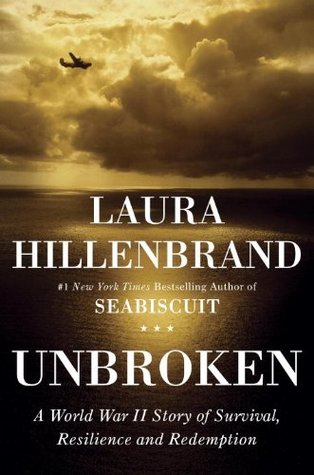
Review of ‘Unbroken’ by Laura Hillenbrand (Through the Shelf Thursday #8)
Title: Unbroken
Author: Laura Hillenbrand
Genre: History, Biography, World War II
Description from Goodreads:
On a May afternoon in 1943, an Army Air Forces bomber crashed into the Pacific Ocean and disappeared, leaving only a spray of debris and a slick of oil, gasoline, and blood. Then, on the ocean surface, a face appeared. It was that of a young lieutenant, the plane’s bombardier, who was struggling to a life raft and pulling himself aboard. So began one of the most extraordinary odysseys of the Second World War.
The lieutenant’s name was Louis Zamperini. In boyhood, he’d been a cunning and incorrigible delinquent, breaking into houses, brawling, and fleeing his home to ride the rails. As a teenager, he had channeled his defiance into running, discovering a prodigious talent that had carried him to the Berlin Olympics and within sight of the four-minute mile. But when war had come, the athlete had become an airman, embarking on a journey that led to his doomed flight, a tiny raft, and a drift into the unknown.
Ahead of Zamperini lay thousands of miles of open ocean, leaping sharks, a foundering raft, thirst and starvation, enemy aircraft, and, beyond, a trial even greater. Driven to the limits of endurance, Zamperini would answer desperation with ingenuity; suffering with hope, resolve, and humor; brutality with rebellion. His fate, whether triumph or tragedy, would be suspended on the fraying wire of his will.
Date I Finished Reading: November 27, 2012
My Rating: 4 of 5
My Review: (also on Goodreads, Amazon):
I have been on a young adult kick lately, so this is the first adult book I have read in a while. A friend of mine lent it to me and told me it was one of the best history books he had ever read; not just about World War 2, but in general. The author, Laura Hillenbrand, is well known for her triumphant Seabiscuit (which I did not read, but loved the movie); so with all the buzz around the book and my friend’s recommendation I gave it a shot.
I’m so glad I did. What an AMAZING story! If the book wasn’t so well documented it would be hard to believe it was true. We read the story of Louie Zamperini and how he goes from rough teenager, to Olympic runner, to World War II airman, to floating survivor, to tortured (physically) POW, to tortured (emotionally) war survivor, to a redeemed man who finds peace in his life.
Honestly, you couldn’t make this stuff up; and that’s where Hillenbrand’s success lies…she didn’t make it up. She spent almost a decade researching and meeting the people that affected Zamperini’s life: family, fly-mates, even the POW guards. We become intimate with not only the main character, but those around him. Her style of writing gives us depth, but personally it’s also one of the flaws of the book. I want substance, I want to know about other people, but Hillenbrand seemed to go on tangents where one minute I was reading about Louie and the next minute I was reading about somebody completely different (and wondering why I wasn’t reading about Louie). That is one reason I gave the book a 4 – it wasn’t because of the story, but more because I disagreed with the writing, or how it was put together. I wanted the book to focus on Louie. Bring in family and friends and enemies, I want to know about them, but keep the focus on Louie.
Another issue I had with the writing is there were times when Hillenbrand seemed to repeat herself. I would spend a page reading about how a time in Louie’s life and how he felt and I would feel like I was right there, eating it all up. Then she would share another tidbit, maybe a couple of paragraphs of side information, which was fine. But then she would go back to talking about the same information as before, but do it in a way as if she had not been talking about it…like she was introducing it for the first time; with the same vigor and seriousness that she had the first time. I felt like she was trying to draw me in…again. And it wasn’t needed. This happened multiple times.
So again, the story itself and all the characters involved gave me an insight to World War II and POW camps that I would have never imagined and made me want to turn the page to find out more. My respect for those in uniform has grown exponentially. The stats alone are enough to make anyone pause. There is not a single doubt that the author did her homework, and the people come out in the story, but at times the writing made the story repetitive and maybe a little forced. I’m not sure if the book knows what it wants to be. While the book seems like it wants to be a biography, I can’t really say that it is…100%. It’s like Hillenbrand wanted to fit as much information about aviation and POW camps from WW2 into one man’s story.
But, all that aside, a phenomenal story very much worth the read!
Have you read ‘Unbroken’? What did you think?